
An Introduction To Assamese cuisine


Assamese cuisine and Assamese recipes are unique of its kind. It has a little similarly with the cuisine and recipes of other Northeast Indian states but Assamese cuisine and recipes doesn't match with the cuisine and recipes of other Indian states.
Before you know what is Assamese cuisine, let me tell you a little bit about Assam and the various communities of Assam.

Assam is a state in the Northeast part of India. It is the heart among the 8 Northeastern states of India. Assam is well known for its wildlife and tea plantation. Assam is famous for one horned rhino, the Maa Kamakhya temple and the mighty river Brahmaputra. Assamese Society is a multi ethnic, multi linguistic and multi religious society. In Assam there are many tribes living, having their own language,  culture, customs, traditions and of course own cuisines.  So Assamese cuisine is the cuisine of Assam and its different multi ethnic  communities and tribes living in different parts of Assam.

 
    Assamese people are well know for their excellent hospitality.  Rice is the main food and fish is an everyday business.  A traditional Assamese meal begin with khar and at the end of the meal tamul paan is served.

 Assamese cuisine can be described in the following headings:


Rice:

An Assamese lunch platter served in bell metal utensil
Photo credit : Sampurna 

Rice is the main ingredient of Assamese cuisine. Some particular rice are grown in Assam alone such as sticky rice (bora chawl), aromatic rice (joha chawl) etc. Rice is served in lunch and dinner. In everyday cooking, Assamese people likes to eat plain rice or boiled rice. Boiled rice is served basically with sour fish curries which are Assamese peoples' favourite dish. Rice is also served with lentils or different dals and vegetable found in this part of northeast India such as feddlehead ferns,  colocasia, spinach, water spinach, mustard plant, mustard green, amaranth, green amaranth, white goosefoot etc. Meat is also served with rice. Assamese people usually eat chicken, mutton, duck meat, pork etc.
Almost all Assamese specially in rural areas like to have rice in both lunch and dinner.

Khar:

Khar prepared from banana peel
Kolkhar 

Khar is an alkali prepared from sun dried skin of some varieties of banana. It is prepared by filtering the water from the burn ashes of the skin of the banana. Therefore it is also called kolkhar (kol means banana). It is preserved in bottles and can be used for months. It sounds bizarre but Assamese people are using khar as a cooking ingredient since time immemorial when salt was not discovered. It is believed that khar cleanses the stomach.

 A traditional Assamese meal begin with khar recipe.  A khar recipe can be prepared with raw papaya, bottle gourd, dry Jasmin flower,  doron bon xaak, fish head etc. In a khar recipe khar is the key ingredient.  One or two tablespoons is enough to prepare khar recipe.  Khar can also be consumed as raw by just adding chopped garlic,  few drops of mustard oil and salt.

Pitika:

Pitika 

Pitika means mashed. Pitika is the  signature recipe of Assamese cuisineAssamese people love to eat vegetables by mashing them with chopped onion, chilli and mustard oil after boiling or smoking/grilling them. Its taste is very pure. Sometimes raw onion is used and sometimes fried onion is used in these recepies. In Assamese cuisine mustard oil is used for all purposes as it can also be consumed  as raw. Pickled chilli or pickled bhut jolokia adds more taste to these dishes. These pitika recipes are great appetizer and generally takes very less time to prepare. 

Greens and vegetables:


Different herbs and medicinal plants and leafy vegetables are available in Assam such an fiddlehead ferns,  skunk vine,  colocasia leaves,  modhuxulung etc. These herbs,  greens and vegetables are generally eaten by simple frying, adding into different lentils, fish or meat. Green leafy vegetables are called xaak which are important part of Assamese cuisine. Greens and vegetables are grown and some found in wild.

Fish dishes:
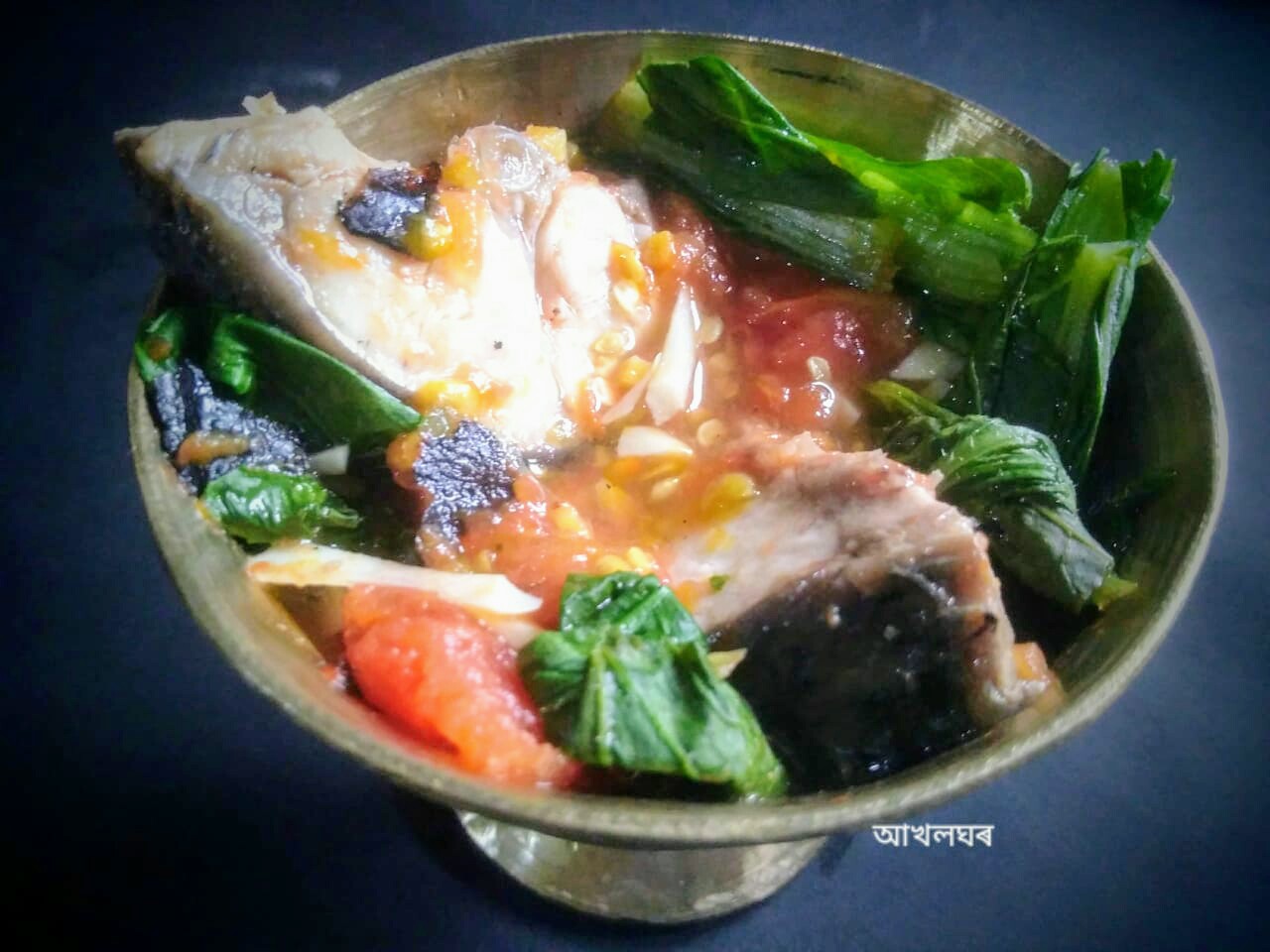
Boiled fish cooked with greens
P. C. Sampurna 

Sour fish curries (masor tenga) are Assamese people's all time favorite.  An Assamese can eat sour fish curry everyday. In other words an Assamese can eat fish in every dinner or lunch.The mighty river Braumaputra and its sub-rivers are wondefull sources of some good river fish. There are many indigenous fish found in Assam. Assamese love to eat fish by making sour fish curries or by grilling on open fire and making pitika and also by cooking in banana or turmeric leaves. Each and every part of a fish is cooked and liked by Assamese people  including fish head and of course intestine parts. Masor patu or fish intestine is cooked in many different ways and liked by the people of Assam.

Meat dishes:


Local chicken, squab, mutton, duck and pork are very popular among indigenous people of Assam. In Assamese cuisine less amount of spices and oil are used. Meat are generally cooked in less oil with fresh herbs and spices. Ginger garlic is used as a basic spice in cooking meat.

Tea:

The Tea production and consumption was introduced in Assam by the British during the British regime in India. There are about 765 tea estates in Assam and about one lakh small tea gardens all over Assam.  Most of Assamese people wake up in the morning and the very first thing they do is to sip a delicious cup of tea.  It's a common practice in many household in Assam. Drinking tea in cups is a modern practice but Assamese serve tea in bell metal bowls. 

Pitha & Jolpan:


Assamese jolpan
Doi Chira Jolpan 

Pitha are sweets and savourys made during Bihu festivals with sticky rice, coconut, black sesame and jaggery.

Jolpan are type of snacks, ofen served as breakfat. Jolpan are also served to guests and during Bihu festivals.

Tamul paan:


Tamul is areca nut and paan is betal leaf. Tamul pan is an integral part of Assamese society.
Tamul paan served in Bota 

Tamul is areca nut and paan is betal leaf. Tamul pan is an integral part of Assamese society. Tamul pan is served as a pair with some lime (sun). Areca nut is first peeled and then cut into pieces. Betel leaf is also cut into pieces and then served with pieces of areca nuts. Tamul paan is offered whenever a guest visits in a bell metal utensil called Bota as a mark of honour. Tamul paan is more often served at the end of an Assamese meal for just as a refreshment.

Comments

Popular posts from this blog

List of Vegetables used in Assamese Cuisine with their English name.

Here is a list of 50 leafy and non-leafy vegetables used in Assamese cuisine with their English name.         Assamese name = English name  Lai xaak(āϞাāχ āĻļাāĻ•)= Mustard green  Paleng xaak(āĻĒাāϞেং āĻļাāĻ•)= Spinach  Horiyoh xaak(āϏ⧰ি⧟āĻš āĻļাāĻ•)= Mustard plant  Dhekia(āĻĸেāĻ•ি⧟া)= Fiddlehead ferns  Meethi xaak(āĻŽিāĻĨি āĻļাāĻ•)= Fenugreek greens Mati kaduri(āĻŽাāϟি āĻ•াāĻĄুā§°ি)= Sessile joyweed  Lofa xaak(āϞāĻĢা āĻļাāĻ•)= Chinese mellow   Bor-manimuni(āĻŦā§°-āĻŽাāύিāĻŽুāύি)= Asiatic pennywort  Sofguti(āϚāĻĢāĻ—ুāϟি)= Fennel  Dangbodi(āĻĄাংāĻŦāĻĻি)= Yard long been  Kolmou(āĻ•āϞāĻŽৌ)= Water spinach  Titamora(āϤিāϤাāĻŽā§°া)= Jute plant  Tengamora(āϟেāĻ™াāĻŽā§°া)= Roselle  Bhekuri(āĻ­েāĻ•ুā§°ী)= Indian nightshade  Squash(āϏ্āĻ•āϚ্)= Chayote squash  Bahgaj(āĻŦাāĻšঁāĻ—াāϜ)= Bamboo shoots  Betgaj(āĻŦেāϤāĻ—াāϜ)= Rattan shoots  Sojina(āϚāϜিāύা)= Drumstick  Maan-dhania(āĻŽাāύ āϧāύি⧟া)= Long coriander  Mosondori(āĻŽāϚāύ্āĻĻā§°ি)= Heart leaf  Bhedai lota(āĻ­ে...

List of Fruits found in Assam with their English Names

Here is a list of fruits found in Assam with their English names.  Assamese Name = English Name  Kordoi (āϕ⧰āĻĻৈ) = Starfruit (Scientific name : Averrhoa carambola) Lichu (āϞিāϚু) = Litchi (Scientific name : Litchi chinensis) Matikothal (āĻŽাāϟিāĻ•āĻ াāϞ) = Pineapple (Scientific name : Ananas comosus) Komola (āĻ•āĻŽāϞা) = Orange  Noga Tenga (āύāĻ—া āϟেāĻ™া) = Rhus srmialata Ahom Bogori = Peach (Scientific name : Prunus persica) Kothal (āĻ•āĻ াāϞ) = Jackfruit (Scientific name : Artocarpus heterophyllus) Siral (āϚিā§°াāϞ) = Mouse Melon (Scientific name : Melothria scabra) Torbuj (āϤ⧰āĻŦুāϜ) = Watermelon (Scientific name : Citrullus lanatus) Bogori (āĻŦāĻ—ā§°ী) = Jujube ( Scientific name :  Zizyphus jujuba) Modhuri (āĻŽāϧুā§°ী) = Guava  Jamuk (āϜাāĻŽুāĻ•) = Malabar Plum, Java Plum or Black Plum (Scientific name : Syzygium cumini) Aam (āφāĻŽ) = Mango   Mouchumi (āĻŽৌāϚুāĻŽি) = Sweet Lime (Scientific name : Citrus limetta) Lataku (āϞেāϤেāĻ•ু) = Baccurea (Scientific name : Baccurea sapida) Dalim ...

Pork with mustard greens (Lai xaak)

Mustard green is a green leafy vegetable. I love its taste.  Its little bitter but it taste good once cooked.  Many recipes can be made with this beautiful green leafy vegetable. Fish with mustard greens , mustard greens stir fry, mustard green raw chutney,  boiled mustard greens are some of the mustard greens recipes.    Pork with mustard greens is a very special recipe of  Assam . Use full grown mature and soft mustard green leaves only. This recipe is very simple and very less spices are used. Assamese cuisine  is in fact less spicy compared to other Indian cuisines.  Pork with mustard greens is served as a side dish with rice. Assam is a rice eating state and Assamese generally eat rice at lunch and dinner.  So this pork  recipe can be served at lunch and dinner with steamed rice. But some people don't like to have leafy vegetables at night.  So for them serve at lunch only. Pork with mustard greens (Lai xaak) ...

List of Spices(āĻŽāϚāϞা) with their English and Assamese names

 Here is a list of 25 spices (āĻŽāϚāϞা) with their English and Assamese names.  Assamese name = English name  Ada (āφāĻĻা) = Ginger (Scientific name : Zingiber officinale)  Nohoru (āύāĻšā§°ু) = Garlic (Scientific name : Allium sativum)  Piyaj (āĻĒি⧟াāϜ) = Onion ( Scientific name : Allium cepa)  Dhania (āϧāύি⧟া) = Coriander ( Scientific name : Coriandrum sativum)  Jeera (āϜিā§°া) = Cumin (Scientific name : Cuminum cyminum)  Ronga guri jolokia (ā§°āĻ™া āĻ—ুā§°ি āϜāϞāĻ•ী⧟া) = Red chilli powder  Hukan jolokia (āĻļুāĻ•াāύ āϜāϞāĻ•ী⧟া) = Dry chilli  Kola nimokh (āĻ•āϞা āύিāĻŽāĻ–) = Black salt  Long (āϞং) = Clove ( Scientific name : Syzygium aromaticum)  Dalsini (āĻĻাāϞāϚিāύি) = Cinnamon  Elaichi (āχāϞাāϚী) = Cardamom  Kala jeera (āĻ•'āϞা āϜিā§°া) = Black cumin  Saunf (āϚ'āĻĢ) = Fennel seeds ( Scientific name : Foeniculum vulgare)  Methi (āĻŽিāĻĨি) = Fenugreek ( Scientific name : Trigonella foenum-graecum ) Haldhi (āĻšাāϞāϧী) = Turmeric  Tejpat (āϤেāϜāĻĒাāϤ) = Bay leaf  Jaluk (āϜাāϞুāĻ•) ...

Fish Curry with Ul Kobi (Kohlrabi)

Fish Curry with Ul Kobi (Kohlrabi) is a simple yet delicious fish curry recipe for those who love Kohlrabi. When I was a kid I didn't liked the taste of  kohlrabi and yes of course my kids don't like it either. As I grew up I developed the taste and now kohlrabi is one of my favorite vegetable. Ul Kobi or Kohlrabi is a root like vegetable but actually related to cabbage family is a versatile vegetable that can be added in salad, fish curry, meat curry etc. Kohlrabi has a cabbage like smell and taste like broccoli stems. It has lots of health benefits. Fish Curry with Ul Kobi (Kohlrabi)  📎 Course :  Main Course  📎Cuisine :  Indian đŸ”ĒPreparation Time : 15 minutes ♨Cooking Time : 30 minutes 🕞Total : 45 minutes 🍴Servings :  2 INGREDIENTS: 1 whole Kohlrabi  1 potato  1 tomato, chopped  4 pieces of fish (any)  1/2 tbsp ginger garlic paste  1/2 tsp  panch phoron 1/2 +1/2 tsp turmeric powder...

Fish Curry with Dry Elephant Apple (Ou Tenga)

Hey there!  I'm back again, after a long time. It's more than six months now, that I haven't written a single word in my blog. Sometimes staying motivated  to keep posting new posts everyday isn't so easy. But, I am back with a new recipe now. It's a simple Assamese style fish curry recipe or masor tenga cooked with dry elephant apple ( ou tenga ).  Dillenia indica, commonly known as elephant apple (ou tenga in Assamese) is used as a souring agent in Assamese cuisine.  We can eat both raw (by making a chutney) and cooked elephant apple. Assamese people eat ou tenga by adding it in lentil curry (dail) and by making sour fish curry (masor tenga). We can also preserve elephant apple by just sun drying it. At first let me share the recipe of Sun dried elephant apple.  Sun Dried Elephant Apple : INGREDIENTS: 1 elephant apple  METHOD: STEP 1  Remove the petals of the elephant apple with the help of a sharp knife.  STEP 2 Cut the soft petals into small ...

Alpine Retreat : Best Homestay In Guwahati : A Review

 If you are looking for a best homestay in Guwahati, then I will highly recommend to check out the  Alpine retreat homestay, a lovely urban apartment at the right of the  heart of the area.  During our last visit to Guwahati, we had decided to stay at a homestay instead of staying in a hotel. The reason of choosing a homestay over a hotel is that we wanted a homely atmosphere and a homestay is a kind of accommodation where tourists are treated like guests, not clients and they are given rooms to stay together with the host family in the same house. A homestay is after all someone's home. In homestay we don't have to confined in a single room just like in a hotel. As the American novelist Edgar Watson Howe beautifully quoted  "To be an ideal guest, stay at home. ".  Alpine retreat is a lovely urban apartment that provides homestay with patio. Just 4.5 km from Paltan Bazar railway station, located on the G.S road,  Alpine retreat is easily accessible an...

Kumol Saul Jolpan

Assam soft rice or Kumol saul is instant soft rice that requires no cooking. Kumol saul is a glutinous rice found in Assam which is pre cooked and sun dried. It is also known as magic rice as it can be prepared in minutes by just soaking in water. Kumol saul is mostly served with boiled milk or curd , banana and jaggery. Although it's a breakfast recipe but kumol saul jolpan is also served to guests specially during bihu festivals. This Assam soft rice or Kumol saul got geographical indications (GI) tag in the year 2018.   Jolpan is an Assamese word which means snacks which are often served in breakfast. Below is the recipe of Kumol saul jolpan : Kumol Saul Jolpan: 📎 Course : Breakfast   📎Cuisine :  Assamese  đŸ”ĒPreparation Time :  25 minutes ♨Cooking Time : 0 minutes 🕞Total : 25 minutes 🍴Servings :  2 INGREDIENTS: 1 1/2 cup kumol saul 1 cup curd 1/2 cup jaggery  1/2 cup cream (optional) METHOD: Soak kumol saul in warm water for 15-20 minutes...

Assamese Herbs & Spices: The Secret Flavours of Northeast India

  The Secret Ingredients: Local Herbs and Spices That Define Assamese Flavours. Assamese herbs and spices are unique of its kind. When you step into an Assamese kitchen, the aroma is unlike anywhere else in India. It’s subtle yet deep — earthy greens simmering in mustard oil, the faint sourness of fermented bamboo shoot, and the warmth of fresh herbs gathered just moments ago. The traditional Assamese cuisine doesn’t rely on heavy garam masalas or rich gravies; its beauty lies in its simplicity — in the way fresh herbs and local spices capture the very essence of Assam’s rivers, fields, and forests. In this post, let’s explore some of the unique herbs and spices that give Assamese food its identity — ingredients that make each dish a story of the land itself. Manimuni (Asiatic Pennywory / Centella Asiatica) A humble creeping herb found near ponds and gardens, manimuni is a cornerstone of Assamese home cooking. It has a mild bitterness and an earthy aroma that refreshes the palate....